CSR Classics
- 4.0
- Rating
- 10.00M
- Installs
- Free
- Price

 Analysis by App-foxy
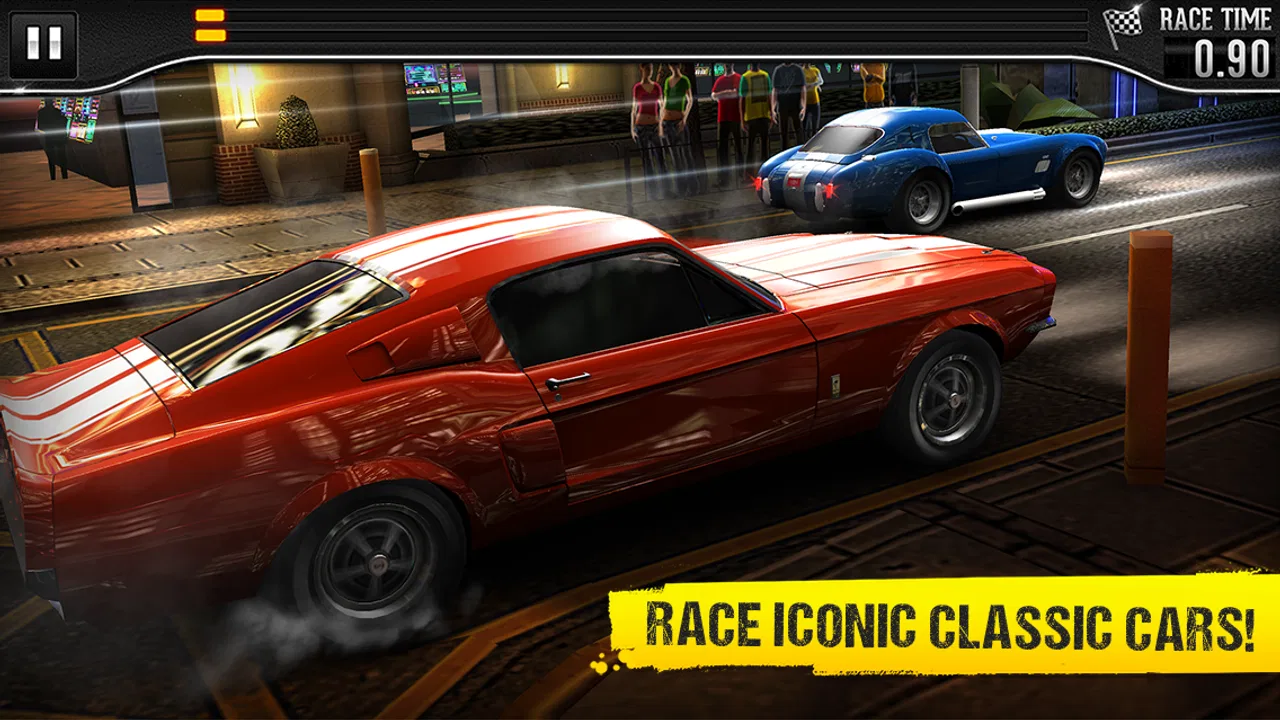
Classic cars have a very particular appeal: they look dramatic before they even move, and they suggest a slower, more deliberate kind of driving than a modern supercar game. That was my first reaction to CSR Classics. It is a free racing game from Zynga that focuses on famous older cars, short races, garage improvement, and the satisfaction of making a worn-looking machine competitive again. I found its strongest quality in the way the visual style, engine sounds, menus, and race structure all point toward the same mood.
This is not a racing game built around long circuits or open-world wandering. Most of the action is concentrated into brief acceleration contests, which makes it easy to play during a short break. At the same time, the upgrade path gives those small races a longer purpose. You are not simply tapping through isolated events; you are trying to build a garage that can handle increasingly demanding opponents without losing the character of the cars that attracted you in the first place.
The game is listed as a Racing title, carries an Everyone age rating, and can be installed for free on compatible Android devices. Zynga released it on April 1, 2014, and the current version is 3.1.4, with Android 5.0 or later required. Its average rating sits at 4.0 from around 893 thousand ratings, while the game has passed 10 million installs. Those figures suggest that the format has reached a broad audience, but they do not remove the need to understand its particular style before downloading it.
You May Also Like

 Blood Strike: 2.5 Anniversary
Blood Strike’s Loadouts Turn Every Drop Into a Tactical Gamble
A close look at Blood Strike’s custom loadouts: how fast access to signature weapons reshapes its battle royale rhythm, rewards preparation, and narrows the gap between fights.

 Pandora - Music & Podcasts
Pandora’s Music Is Easy to Start, but Harder to Recover
Pandora’s strength is its low-effort path from a seed to a station. Its weak spot is how much confidence it asks you to place in connection, setup, and quiet recovery.

 8 Ball Pool
 Is Built on Rivalries, Rematches, and Routine
A close look at the rivalries, rematches, shared routines, and unanswered safety questions that turn a quick pool match into a persistent mobile community.

 Samsung Music
’s Quiet Strength Is Playing What You Already Own
Its reach comes less from spectacle than from dependable access to a personal library. That simplicity is both the app’s strongest retention engine and its ceiling.

 AccuWeather: Weather Radar
AccuWeather Review: A Quick, Clear Forecast for Everyday Decisions
For everyday plans, the best forecast is the one you can understand quickly. AccuWeather makes rain timing, radar, and local conditions easy to act on, with a few trade-offs.

 Hill Climb Racing
Why Hill Climb Racing Still Turns Crashes Into One More Run
A tiny car, a bumpy hill and one more upgrade: Hill Climb Racing keeps resurfacing because its simple chaos makes every near-miss feel personal.
More From Our News Desk



Why the first few races work so well
The opening experience is easy to understand. I choose a car, enter a short race, and concentrate on the launch and gear changes rather than steering through a complicated track. That simplicity is important because it lets the cars provide the initial excitement. The game wants me to notice the shape of the vehicle, the feeling of the engine coming alive, and the difference between a clean shift and a mistimed one.
There is a useful tension in that design. The controls are approachable enough for a casual player, but the races are not completely automatic. A good start can make an immediate difference, and shifting at the right moment gives the short events a satisfying sense of participation. I never feel as if I am driving a full simulation, yet I also do not feel that the result is entirely decided before I touch the screen.
The short format suits everyday play. If I have a few minutes while waiting for an appointment, I can complete a race and make a small amount of progress without committing to a long session. A longer evening session has a different rhythm: I can move between races, inspect the garage, improve a car, and return to an event that previously felt just out of reach. That loop is more compelling than the individual race mechanics alone.
One practical tip is to resist upgrading every vehicle as soon as a new part becomes available. Early resources are easier to manage when I focus on the car that is actually blocking progress. Spreading improvements across too many vehicles can leave several cars mediocre instead of making one reliable machine strong enough to carry the next group of events. That is one of the first trade-offs I noticed: collecting cars is enjoyable, but maintaining a useful competitive garage requires restraint.
The game also benefits from a clear visual identity. The cars are presented as objects worth examining, not just anonymous shapes used to move from one finish line to another. That matters because the central appeal is not only winning. It is seeing a classic model become more capable while preserving its older, less polished personality.
A garage that feels like part of the game world
The garage is where the collection idea becomes more personal. I spend time deciding which car deserves attention, which vehicle should be saved for a particular event, and whether an upgrade is worth its cost right now. This creates a small planning layer between races. It is not deep enough to replace a full management game, but it gives the cars a role beyond appearance.
I especially like the way the garage slows the pace down. The races are quick and focused, while the preparation phase encourages a more careful look at the collection. That contrast helps the setting feel coherent. The game is not constantly shouting for speed; it gives me a moment to appreciate the machinery before asking me to perform.
For a new player, the most useful habit is to check the requirements of the next event before spending currency. A car that looks attractive may not be the best immediate investment if another vehicle is better suited to the upcoming challenge. I also found it sensible to replay manageable races when I needed a safer way to build resources rather than repeatedly forcing a difficult event with an underprepared car.
That advice reveals one of the game's limitations as well. Progress can become less about learning a new racing technique and more about waiting until the garage is ready. If you prefer a racing game where improvement comes mainly from mastering corners, braking points, and track layouts, this may feel too narrow. Here, preparation and timing matter more than route knowledge.
How the art direction establishes its mood
The visual language is built around age, metal, and mechanical personality. The cars have a strong presence, and the presentation encourages me to treat them as the stars of the experience. Instead of surrounding them with a bright, playful fantasy setting, the game leans into a more grounded automotive mood. That choice makes even a short race feel like part of a larger collection of machines with history behind them.
I found the setting most effective when the menus and garage support the same feeling as the races. The interface is there to move me toward the next event, but it also keeps attention on the cars and their progression. This consistency is easy to overlook, yet it is a major reason the game feels more distinctive than a generic collection of tap-to-race challenges.
The presentation also affects pacing. Because the races are brief, the game needs the garage and surrounding screens to provide a sense of pause. Without that contrast, the repeated acceleration contests could become mechanical very quickly. The visual treatment gives the pauses a purpose: I am not merely waiting for another race; I am looking at the collection, considering the next investment, and returning to the atmosphere of classic motoring.
One non-obvious strength is that the older-car theme makes modest progress feel meaningful. In a game filled with futuristic vehicles, a small performance improvement can disappear behind spectacle. Here, the change feels connected to the identity of the car. The result is not a transformation into a completely different machine, but a more capable version of the same character.
Sound and the rhythm of each race
Sound plays an important role in making the races feel more physical. The engine note, the launch, and the gear changes give the player clear moments to anticipate. I do not need a complex track layout to feel a rise in tension; the rhythm comes from listening, watching the timing, and trying to make the next input cleanly.
This is where the game separates itself from a purely visual tapper. The race may be short, but it has a beginning, a build, and a release at the finish. A poor launch creates immediate pressure, while a well-timed sequence can make the same vehicle feel much more responsive. The sound therefore supports the mechanics rather than acting as decoration.
I recommend playing with audio enabled when possible, especially during the first sessions. The visual cues remain important, but the sound helps establish the timing of the race. In a noisy environment, the experience becomes less satisfying because part of the feedback loop is weakened. That is a realistic consideration for commuters or anyone playing casually with the phone muted.
The rhythm can become repetitive over time. Since the core events follow a similar pattern, players who need constant changes in scenery or handling may run out of novelty sooner than expected. I see this as a deliberate consequence of the focused design rather than a flaw that can be ignored. The game works best when I enjoy refining a small sequence and building a collection, not when I expect every race to feel like a new driving challenge.
Where the mechanics fit—and where they do not
The mechanical design is a good match for players who want accessible racing with a light progression system. Starting, shifting, upgrading, and choosing the right car are understandable without a long tutorial. That makes the game friendly to people who do not normally play detailed racing simulations, while still giving experienced mobile players a reason to care about timing.
Its main limitation is the lack of broader driving control. I am not navigating a winding course, managing traffic, or choosing racing lines. The challenge is concentrated into acceleration and preparation. That focus gives the game its speed and convenience, but it also means the experience cannot satisfy every kind of racing fan.
Compared with an arcade racer built around steering and dramatic tracks, this feels more like a sequence of mechanical tests. Compared with a simulation, it is far more forgiving and much less concerned with realistic car behavior. Its closest appeal is for someone who likes the collection and tuning side of racing but wants races that can be completed quickly.
The free entry point is helpful, but the in-app purchase range runs from $0.99 to $99.99 per item. I would approach the economy with a fixed personal limit rather than buying impulsively when progress slows. The game is easier to enjoy when I treat upgrades as planning decisions and accept that not every event needs to be cleared immediately. Players who dislike any pressure around optional spending should be aware that the free structure may not feel completely frictionless.
Another useful trade-off concerns patience. Replaying races can be a sensible way to strengthen a car, but it can also make progress feel repetitive. If I am willing to repeat a familiar event for resources, the upgrade loop remains manageable. If I want constant forward movement with no revisiting, the pacing may become frustrating. That difference is more important than the simple label of “free,” because the real question is how comfortable I am with gradual progression.
Who will enjoy the collection most
I would recommend this game to someone who likes classic-car styling, short competitive rounds, and gradual garage development. It is particularly suitable for players who want a racing game that fits around a busy day. A quick session can still have a clear goal: improve a car, clear one event, or test whether a timing adjustment is enough to win.
It is also a good choice for a player who enjoys making decisions with limited resources. The most satisfying moments often come before the race, when I decide whether to improve the current vehicle, save for a more important part, or switch to another car. That planning gives the simple controls more weight than they would have on their own.
I would skip it if my ideal racing game requires free driving, varied circuits, deep handling, or a strong sense of speed over long distances. I would also be cautious if repeated events and upgrade-based progression quickly lose my interest. A conventional track racer would be a better fit for someone who wants to practice corners and discover different road layouts, while a more simulation-focused title would suit players looking for detailed car behavior.
For families, the Everyone rating makes the game broadly approachable in terms of age classification. Still, the purchase options mean I would set expectations before handing the device to a younger player. The game can be played for free, but the presence of optional items makes basic spending boundaries a sensible part of the setup.
Small habits that improve the experience
My first recommendation is to separate collection goals from progress goals. It is tempting to chase every attractive car, but the garage becomes more useful when at least one vehicle receives consistent attention. A second helpful habit is to treat a loss as information: check whether the problem was the launch, the shift timing, or simply insufficient preparation before spending again.
I also suggest using the garage as a planning screen rather than visiting it only after a defeat. Looking ahead helps prevent wasteful upgrades and makes the next race feel intentional. When I know which vehicle I am developing and why, the repeated structure becomes a deliberate routine instead of a string of disconnected attempts.
Finally, play in sessions that match the game's rhythm. A few races are ideal for a short break, while a longer session works best when divided between racing and garage decisions. Trying to rush through many events can make the repeated pattern feel dull; giving each small improvement a purpose preserves the atmosphere that makes the game appealing.
The atmosphere verdict
What stays with me is the coherence between the cars, the garage, the sound, and the compact race format. The game succeeds when its focused mechanics are treated as part of a classic-car mood, not as a substitute for a full driving simulator. The short races provide immediate interaction, while the collection and upgrade loop give that interaction a reason to continue.
It is not the right choice for every racing fan. The limited driving control, repeated event structure, and free-to-play economy can create friction, especially for players who want variety or uninterrupted progression. Yet those weaknesses are balanced by a clear identity. I always understand what kind of experience it is asking me to enjoy: choose a classic machine, prepare it carefully, listen for the right moment, and see whether a small improvement can turn a close loss into a clean win.
For me, that makes CSR Classics a worthwhile download when I want a compact racing game with more personality than a generic timing challenge. Its best use is as a focused mobile companion rather than a replacement for a console-style racer. If the sight and sound of older cars appeal to you, and you enjoy patient garage planning as much as the finish line, the free starting point is easy to recommend. Just approach the progression with realistic expectations, protect your spending limit, and remember that the pleasure comes from building a competitive collection one carefully chosen improvement at a time.
FAQs for CSR Classics
01What is CSR Classics and what makes it unique from other racing games?
CSR Classics is a drag racing game that allows players to race vintage cars from the 1950s to the 1970s. What sets it apart is its focus on classic cars and the ability to restore them to their former glory, providing a nostalgic experience for car enthusiasts. The game combines competitive racing with a restoration aspect, making it unique in the racing game genre.
02Is CSR Classics free to play, and are there any in-app purchases?
CSR Classics is free to download and play, offering a variety of cars and races. However, it includes in-app purchases that allow players to buy in-game currency and premium items. These purchases can enhance the gaming experience by speeding up the car restoration process or unlocking exclusive vehicles, but they are not necessary to enjoy the game.
03What are the system requirements for CSR Classics on Android and iOS?
To play CSR Classics on Android, the device generally needs to be running Android 4.0 or higher. For iOS users, an iPhone, iPad, or iPod touch running iOS 7.0 or later is required. It's important to ensure your device has sufficient storage space and that the game is compatible with your operating system for optimal performance.
04How does the car restoration feature work in CSR Classics?
In CSR Classics, players can restore classic cars by winning races and earning virtual currency. The restoration process involves upgrading various parts of the car, such as the engine, tires, and bodywork. This feature not only boosts the car's performance but also enhances its appearance, allowing players to transform rusty old vehicles into shiny, high-performance racing machines.
05Can I play CSR Classics offline, or is an internet connection required?
CSR Classics requires an internet connection to access all features and functionalities. While some aspects of the game can be played offline, such as solo races, an internet connection is needed for updating game content, participating in online events, and accessing leaderboards. This ensures players have the most current game experience and can compete globally.
Pros
- Stunning graphics bring classic cars to life.
- Wide variety of vehicles to collect and race.
- Smooth controls for an immersive experience.
- Engaging storyline with nostalgic themes.
- Regular updates with new cars and features.
Cons
- Requires internet connection to play.
- In-app purchases can be quite expensive.
- Progression can be slow without spending.
- Some cars locked behind paywalls.
- Ads can be intrusive during gameplay.

CSR Classics
Gallery